

Case Study: Custom Indoor Air Monitoring IoT System
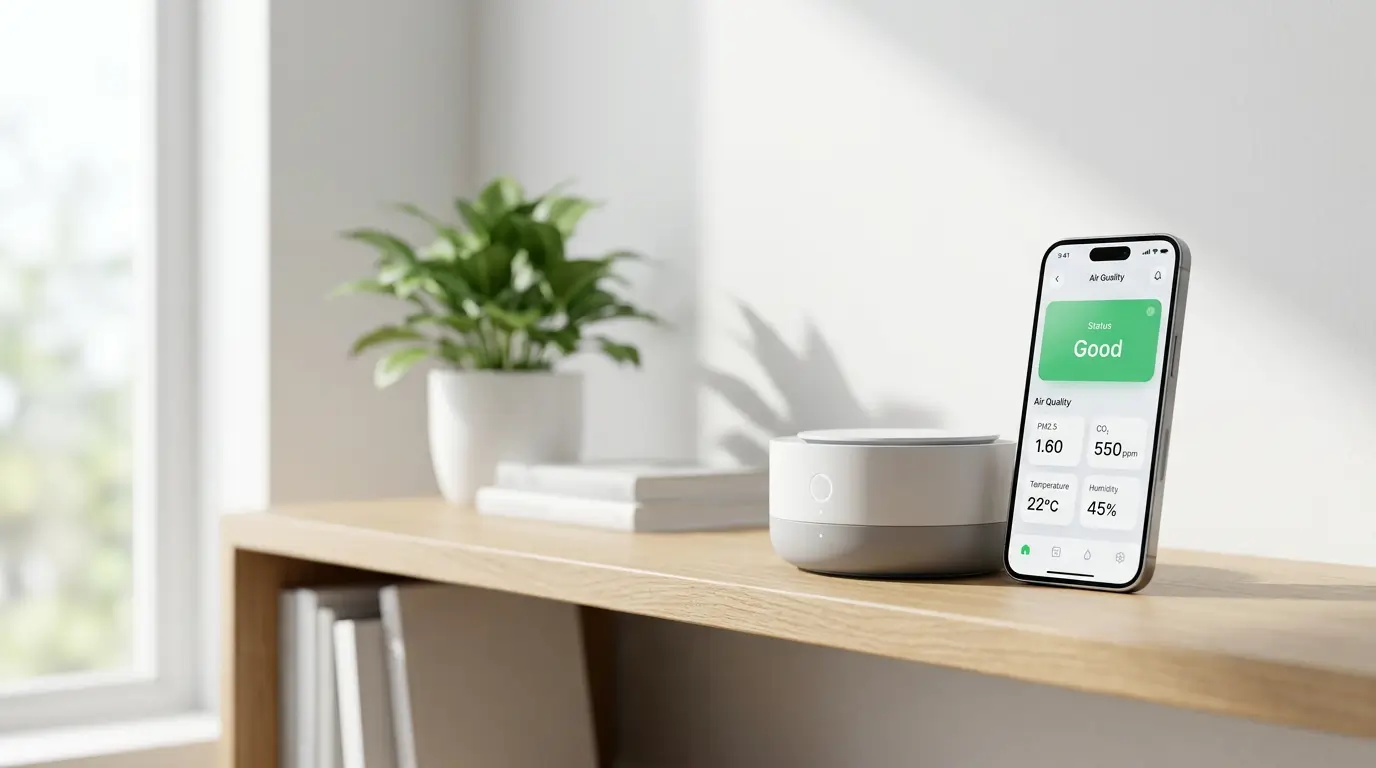
Cube Air is a smart air quality monitoring system designed to help residents stay aware of the air they breathe and know when it needs improvement.
Last updated: 2 Jul 2026
This case study covers Custom Indoor Air Monitoring IoT System: the request the client brought to JuTech, the solution we designed and built, and the impact it delivered.
Story
Short Overview
Cube Air is a smart air quality monitoring system designed to help residents stay aware of the air they breathe and know when it needs improvement. The solution combines a compact desktop device with a clear, user-friendly mobile app that visualizes indoor conditions in real time. Developed for a US company building premium apartments, Cube Air enhances the living experience by tracking indoor air quality.
Project Background
The customer is a developer company constructing hotels and condominiums of premium class in Florida. One of the customer’s projects is an indoor air purifier.
Summary
Industry
High-Tech, Smart Home, Smart Office, Smart City
Service
R&D Services, MVP Development, UI/UX Design, Mobile App Development, IoT App Development, Cross-Platform App Development, Web Development, Back End Development, Front End Development, Database Development, DevOps Services, IoT Development, IoT Consulting Services, Tech Advisory
Team:
8 Engineers
Client’s Location:
USA
Lifetime
2024 - ongoing
+85%
Air Quality Monitoring Accuracy
-60%
Manual Environment Checks
24/7
Real-Time Sensor Monitoring
Request
What was the customer's request?
The client approached Indeema with the request to create a smart air quality monitoring system that would track indoor conditions and notify residents when the air purifier should be activated. They also needed a companion mobile app to provide clear air quality insights to end users.
What did the client already have?
Before starting the project, the customer provided a drawing and a 3D model of the air purifier. Our task was to determine the best location for the air quality monitoring sensor inside the unit and define which air parameters should contribute to the overall AQI. Indeema’s team supported the client with sensor selection and preliminary evaluation.
Solution
Where did we start?
We started from a kick-off meeting where the client described his business and his intention. Indeema team provided R&D during which the sensors and the main processor were selected. Also the team work on requirements for the mobile application.
Process
Requirements phase
During this phase, the team prepared a Functional Requirements document. It became the foundation for the technical specification and guided the development process across hardware, firmware, cloud, and mobile components.
Prototyping and Wireframes
The UI/UX team held several workshops with the client to understand the end user and propose initial design concepts. Meanwhile, the hardware team assembled the device prototype using development kits, allowing firmware engineers to begin work early and avoid blockers.
Firmware/Embedded Development
Our embedded engineers developed the device firmware using the ESP-IDF framework. It collects air quality data from the sensors, processes it locally, calculates AQI, and sends the information to the cloud for real-time display in the mobile app.
UX/UI Design
The team delivered a clean, modern mobile interface aligned with the user scenarios discussed earlier, so the design was approved with only minor adjustments.
Mechanical Design
In phase two, Indeema prepared a 3D model of the desktop version of the device. The client required very specific dimensions, so the team reworked the internal component layout — adjusting PCB placement and optimizing space. We also introduced a clear and visually appealing LED indicator strategy, allowing users to understand air quality at a glance.
Web Development
We developed a cloud-based platform on AWS that connects the device with the mobile application. The system enables two-way communication, real-time data transfers, remote updates, and background processing of incoming device data. This ensures stable performance and provides users with clear insights into their indoor environment.
Mobile Development
Using Flutter, the team delivered a cross-platform mobile app that the client could release quickly on both Android and iOS, ensuring a consistent experience for all users.
DevOps and Cloud Development
The solution uses a serverless AWS cloud architecture with AWS IoT and Lambda functions, which process device data in real time, store it securely, and send updated air quality information directly to the mobile app.
Maintenance
Indeema continued working on Generation 2 of the Cube air device. In this version, the unit became fully portable and no longer needed to be installed inside the purifier — it can simply be placed on a desktop and used as an independent device. The team also added a new CO₂ sensor, and the mobile app was updated with the corresponding readings and additional notifications to support the extended functionality.
Project Challenges
and Our Suggestions
Non-Technical End Users
- The device and app were designed for people with little technical experience, so the interface had to be extremely simple and clear.
- Indeema created a clean, intuitive UI that allows users to understand air quality at a glance without needing any technical knowledge.
Strict Size Constraints for Generation 2
The second-generation device had to be significantly smaller but still fit all internal components.
Indeema redesigned the internal layout, optimized PCB placement, and reorganized components to ensure everything fit inside the compact form factor while maintaining full functionality.
Impact
Indeema delivered a complete air quality monitoring solution, enabling the client to bring their first device to market and install it across premium apartments. The portable Generation 2 model, paired with a clear mobile app, helps residents easily understand indoor air quality and encourages timely purifier use — increasing product adoption and strengthening the value of the client's properties.
Before:
- The client was entering device production and system development for the first time and lacked a solution to clearly communicate indoor air quality to end users.
- No device capable of showing when action was needed to improve air quality.
- No clear way to demonstrate air quality status to encourage users to install the purifier.
- No hardware or system experience to support device creation.
After:
Indeema delivered complete Generation 1 and Generation 2 prototypes, supported manufacturing setup, and developed both hardware and software for a ready-to-test solution.
- Prototypes of two device generations prepared for beta testing.
- Modern portable device with clear LED indication and an intuitive companion app.
- A fully deployable system for installation in premium apartments, helping residents monitor air quality and encouraging purifier adoption when needed.

Live AI Showcase.
Explore the systems we’ve built through an interactive live demo experience the future of digital products and the power of AI firsthand.
