

Case Study: IoT Asset Tracking System
The client required a scalable IoT system to track high-value assets across warehouses and transit routes in real time.
Last updated: 2 Jul 2026
This case study covers IoT Asset Tracking System: the request the client brought to JuTech, the solution we designed and built, and the impact it delivered.
Story
Short Overview
The client required a scalable IoT system to track high-value assets across warehouses and transit routes in real time. The solution needed to provide accurate geolocation, device health monitoring, and centralized visibility through a web dashboard.
Project Background
Traditional tracking methods used by the client were fragmented and lacked real-time accuracy. Manual updates and delayed visibility created inefficiencies in asset utilization and logistics planning. The goal was to replace this with an automated, connected tracking ecosystem.
Summary
Industry
Logistics, Supply Chain, Industrial IoT
Service
IoT Development, Cloud Integration, Embedded Systems, Dashboard Development
Team:
3 Engineers, 1 IoT Architect, 1 PM
Client’s Location:
Europe
Lifetime
2025
-65%
Asset Search Time
+92%
Real-Time Tracking Accuracy
24/7
Live Asset Monitoring
Request
What was the customer's request?
The client needed a unified system to track physical assets in real time across multiple locations. The system had to provide live location updates, historical movement logs, and instant alerts for unauthorized movement or device disconnection.
What did the client already have?
The client had partial hardware deployments and a basic tracking concept. However, they lacked a unified software platform, scalable cloud architecture, and real-time visualization system to make the solution operational.
Solution
Where did we start?
We began with a discovery workshop to define asset types, movement patterns, and operational constraints. This helped shape both hardware selection and system architecture.
Process
Requirements phase
A detailed Functional Requirements Document (FRD) was created covering: Asset tracking behavior rules, Device communication protocols, Data update frequency, Alert conditions, User roles and dashboard access levels
System Architecture Design
We designed a layered architecture: IoT tracking devices (GPS + sensors), Edge communication layer, Cloud ingestion & processing layer, Real-time API services, Web dashboard interface
IoT Device Integration
We started with the IoT device layer, designing compact tracking units equipped with GPS modules and motion sensors to capture real-time asset data. The main focus was to ensure reliable field operation with low power consumption and stable data transmission. To optimize battery life, we implemented adaptive reporting where devices increased or reduced location updates based on movement activity. This allowed the system to maintain tracking accuracy while avoiding unnecessary energy usage, making the devices suitable for long-term deployment.
Backend & Cloud Development
The backend layer was developed as a scalable cloud system to handle continuous data streams from multiple devices. It processed real-time location updates, stored historical movement data, and triggered alerts for events like unauthorized movement or signal loss. A rule-based engine was implemented to detect anomalies and generate instant notifications. The architecture was designed to support growing device networks while maintaining low latency and consistent performance.
Dashboard Development
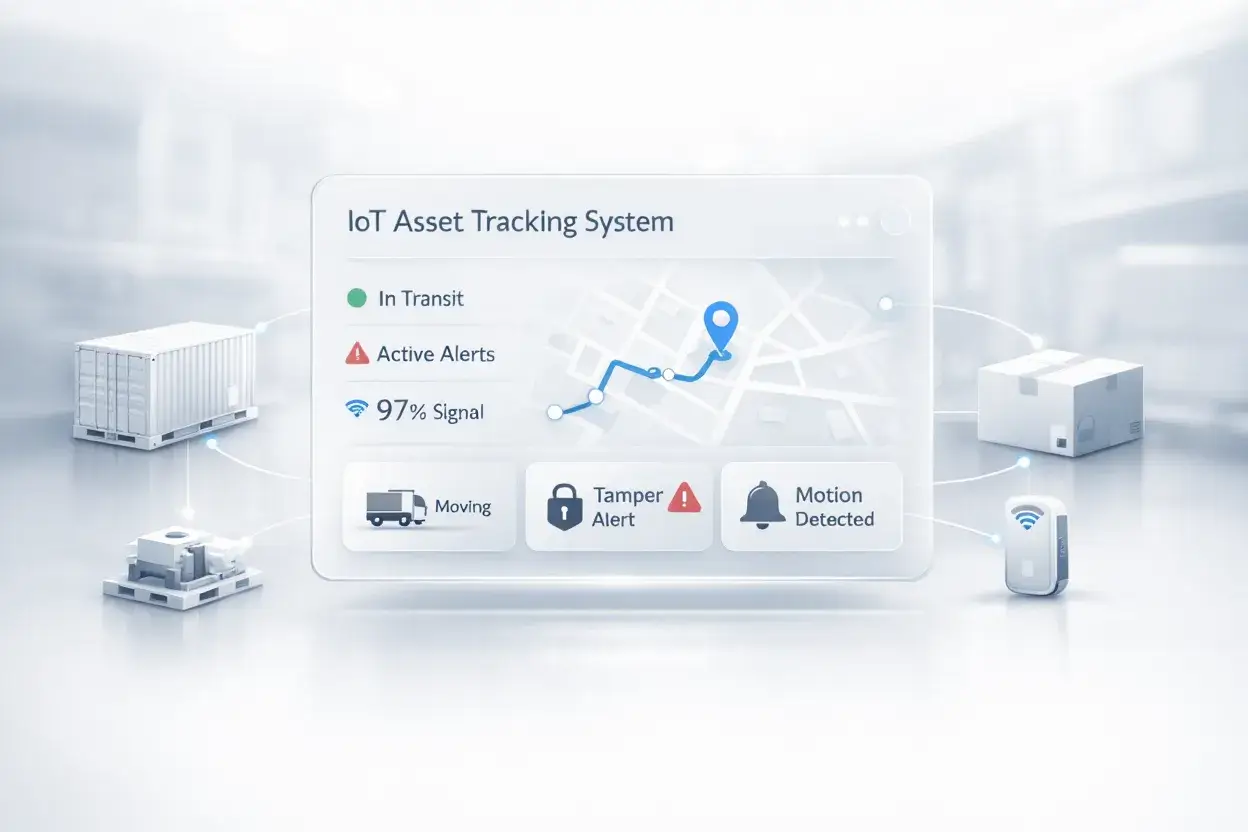
We built a web-based dashboard to provide a unified view of all tracked assets. The interface featured a live map for real-time tracking, along with tools to view movement history, asset status, and event logs. Users could filter assets by location, type, or activity, making it easier to manage large-scale deployments. The focus was on simplifying complex IoT data into a clear and actionable visual experience.
System Integration & Testing
In the final stage, all components—devices, backend, and dashboard—were integrated into a single system. We ensured smooth end-to-end data flow from IoT devices to cloud services and the user interface. Extensive testing was carried out under real-world conditions, including network instability and high data loads. This helped validate system reliability, optimize performance, and ensure the platform was ready for production use.
Project Challenges
and Our Suggestions
Real-time accuracy vs power consumption
We implemented an adaptive tracking strategy where devices adjusted their reporting frequency based on movement. When stationary, updates were minimized, and during motion, the frequency increased automatically. This helped maintain reliable tracking while significantly improving power efficiency.
Connectivity gaps in field environments
We introduced offline data buffering on the device side. When connectivity was lost, data was stored locally and automatically synced once the network was restored, ensuring no loss of movement history.
High data load at scale
We optimized the backend using event-driven processing and data aggregation techniques. Instead of processing every raw update equally, the system grouped and prioritized data streams to maintain low latency and stable performance even under heavy load.
Impact
The IoT Asset Tracking System enabled real-time visibility of assets through a centralized dashboard, reducing dependency on manual tracking and delayed updates. Automated alerts for movement, tampering, and connectivity loss improved response times and helped reduce risks like asset loss and misuse. The system was also designed to scale, allowing new assets to be added easily while maintaining stable performance under growing data loads.
Before:
- Asset tracking was largely manual or semi-digital, relying on periodic updates rather than continuous monitoring, which created gaps in visibility.
- There was no real-time location tracking, making it difficult to know the exact position of assets at any given moment.
- Tracking data was scattered across different tools or records, leading to fragmented and inconsistent monitoring.
- Updates on asset movement were delayed, which often resulted in slow response times during critical situations.
- The system lacked scalability, making it difficult to efficiently manage a growing number of assets across multiple locations.
After:
- A fully automated IoT-based tracking system enabled continuous, real-time monitoring of all assets.
- A centralized cloud dashboard provided a single source of truth for asset visibility and management.
- Live location tracking across regions allowed teams to monitor movement instantly and accurately.
- Automated alerts ensured immediate notifications for events such as movement, tampering, or signal loss.
- The scalable IoT architecture allowed seamless addition of new assets without affecting system performance.

Live AI Showcase.
Explore the systems we’ve built through an interactive live demo experience the future of digital products and the power of AI firsthand.
